
Grand Capital
Grand Capital review: Offshore Registration, Bonus “Fine Print,” and the Reality of Forex Trading
Grand Capital review. Choosing a broker for trading on the Forex currency market is perhaps the most critical decision in a trader’s career. It affects not only the comfort of trading but also the safety of your invested capital. The Forex market, due to its decentralized nature, attracts many companies operating under different standards and jurisdictions. Some diligently protect client interests, while others exploit every loophole to complicate fund withdrawals or “beat” the trader using internal rules.
Grand Capital has been operating in the market since 2006 and positions itself as an international broker offering a wide range of services: from Forex and CFD trading to investments and PAMM accounts. At first glance, it appears to be a solid player with a long history. However, behind the loud claims of reliability lies a structure typical of many offshore brokers.
In this Grand Capital review, we will dissect what the broker’s regulation actually means, where the company is registered, how its famous bonuses work (and the true cost of these “gifts”), and analyze real trader reviews. Our goal is to provide the most complete and objective picture possible, enabling you to make an informed decision.
Grand Capital review. Jurisdiction and Regulation – The Truth About Offshore Status
One of the first things an experienced trader checks before starting is the broker’s license and jurisdiction of registration. This determines where to turn in case of a dispute and how strictly the state controls the company’s activities.
Grand Capital review. The New MISA License (Union of Comoros): What Does It Really Mean?
On the official Grand Capital website, in the “Regulation” section, it states that in 2024 the company received a license from the Mwali International Services Authority (MISA) . It sounds impressive, but let’s examine what this organization actually is.
MISA is a regulator registered on the autonomous island of Mwali (Ngazidja), which is part of the Union of Comoros. This is a small island nation in the Indian Ocean, a classic offshore zone.
What does this license actually provide?
- Low Entry Barrier: Requirements for share capital, reporting, and “Know Your Customer” (KYC) procedures are minimal. This allows the company to save on costs.
- Lack of Strict Oversight: The local regulator physically lacks the resources to effectively monitor an international broker’s activities. Essentially, the MISA license is a formality and a “shell” that allows the broker to legally accept clients from countries where it has no direct ban on operations.
- Zero Guarantees for Clients: In the event of the broker’s bankruptcy or fraud, clients cannot expect compensation from the state or the local regulator. There are no deposit insurance schemes there.
Thus, the website’s claim that the license “confirms our commitment to global standards of financial regulation” is a significant exaggeration. Global standards refer to licenses from the FCA (UK), CySEC (Cyprus), BaFin (Germany), which impose strict requirements on capital, segregated accounts, and reporting. The Comoros Islands license sits at the opposite end of the reliability spectrum.
What is FinaCom and What It Is Not
It is crucial to understand the difference here:
- A Financial Regulator (like the FCA or CySEC) is a governmental body with legislative power. It can conduct inspections, impose fines, revoke licenses, and initiate criminal prosecution.
- The Financial Commission (FinaCom) is an international non-governmental organization that provides alternative dispute resolution (ADR) services for Forex market participants. Simply put, it’s a private arbitration service.
What does FinaCom membership provide?
- Compensation Fund: Yes, each client can claim compensation of up to €20,000. However, it’s important to understand that the fund is built from contributions from the member companies themselves. It’s not a government insurance scheme but an internal “mutual aid fund.”
- Dispute Resolution: If you have a conflict with the broker, you can file a complaint with FinaCom. It’s faster and cheaper than going to court. The commission will review your case and issue a ruling that the broker, as a member, is obliged to follow.
However, the assignment of “reliability category A” is a marketing tool used by FinaCom itself for its participants. It is not an assessment from an international rating agency (like Moody’s or S&P). It simply means the broker pays its dues and follows the commission’s basic rules.
Conclusion for the Client: Holding an MISA license and FinaCom membership is a standard combination for hundreds of Forex brokers. It does not protect the client from the main risks of offshore trading: conflict of interest, price manipulation (especially during news events), and unfair bonus program terms. In effect, the minimal registration requirements allow the company to operate in a gray area where the law often favors the stronger party (the legal entity) rather than the individual trader.
Grand Capital review. Analysis of Bonus Programs – Generosity at Your Expense
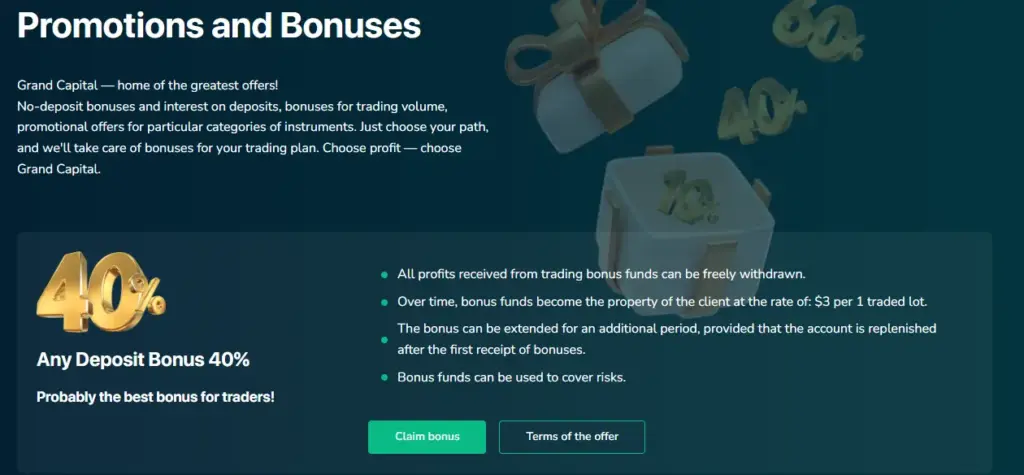
Grand Capital, like most offshore brokers, aggressively uses bonuses to attract clients. The website features offers like “30% bonus on deposit,” “Cashback up to 90% of the spread,” and “100% bonus on first deposit.” This looks extremely appealing to a beginner: deposit $1000, get another $1000 on top – what leverage!
However, in the world of offshore Forex, there’s no such thing as a free lunch. Let’s break down the bonus terms and conditions, which are often hidden in the fine print.
Deposit Bonus: The Illusion of Free Money
The most popular type of bonus is a percentage of the deposit amount, for example, a 30% or 100% bonus. The terms for receiving and “unlocking” it are such that the chance of withdrawing these “gifted” funds approaches zero.
How it typically works (common broker practice):
Grand Capital review. Bonus Funds Are Not Withdrawable
They are credited to a separate bonus account or increase the balance but are considered “credit” funds. You can only withdraw the profit generated by trading them, not the bonus itself.
Volume Requirement
To convert the bonus into real money, the trader must generate a huge trading turnover. For example, with a $1000 bonus, you might need to trade a volume of 100, 200, or even 500 lots. For a small deposit, this is a fantastical volume that will inevitably lead to deposit loss due to commissions/spreads or excessive risk.
Restrictions on Risk Management
Often, the rules state that withdrawing part of the funds before the bonus is unlocked will void the bonus. Additionally, using pending orders or hedging might be considered a “prohibited strategy,” also leading to bonus cancellation.
Grand Capital review. Grand Capital’s Specific Conditions
Analyzing the rules of Grand Capital’s bonus program reveals key points that are significant drawbacks for the client:
Turnover Requirement
For most bonuses, the trader must execute trades with a total volume tens of times greater than the bonus amount. The trader is forced to trade with enormous volume just to “earn back” the gift, often abandoning sound reasoning and market analysis.
Maximum Profit Cap
One of the harshest conditions. The rules for many Grand Capital bonus programs state that the maximum amount available for withdrawal from a bonus account (even after meeting requirements) may be limited. For example, you might only withdraw up to 10% of the total turnover or a fixed sum. Any profit exceeding this limit is forfeited upon withdrawal.
Grand Capital review. Time and Instrument Restrictions
Bonuses often expire if the trader doesn’t remain active for a certain period. Some account types or instruments (e.g., cryptocurrencies) may not count toward bonus turnover, or may count with a reduced coefficient.
Broker’s Priority
- In a dispute, the bonus program rules are interpreted by the broker. In such disputes, FinaCom often sides with the company if the trader violated even the most illogical bonus rule.
Example: A trader deposits $500 and receives a $500 bonus. To withdraw the bonus, they need to trade 500 lots. Trading 0.1 lots per trade, they would need to execute 5000 trades. With an average spread of 1-2 pips, the commission from this turnover would “eat” not only the bonus but also a significant part of the deposit. If the trader accidentally starts trading aggressively and quickly grows the account to $2000, upon attempting withdrawal, the broker may deduct the bonus and limit the profit, citing the rules.
Conclusion: Grand Capital’s bonuses are a marketing tool designed to retain client funds within the company. They are created not to help the trader earn, but to force them to trade as much and as long as possible, generating turnover (and profit from spreads) for the broker, while minimizing the broker’s risk of paying out large winnings.
Grand Capital review. Client Reviews – From Delight to Disappointment
To get an objective picture, it’s necessary to study reviews from real users. Thousands of opinions about Grand Capital can be found online, and they vary drastically. They can be roughly divided into three categories.
Positive Reviews
These reviews are most often left by beginners or the broker’s partners (IBs).
- Arguments “For”: User-friendly platforms (MT4, MT5, web terminal), a large amount of educational material in Russian, prompt chat support, a wide range of instruments, and cent accounts for starting out.
- Who Leaves Them:
- Traders who have successfully withdrawn small profits (up to $1000-$2000) without using large bonuses. They deposited, traded a bit, and closed in profit. These clients are not of great interest to the broker, who readily pays out small sums to maintain its reputation.
- Partners (IBs) who earn a percentage of their referrals’ turnover. They are interested in attracting new clients and actively advertise the broker on forums and social media.
- Lucky individuals who managed to snag cashback or win a contest.
Negative Reviews – What Defrauded Clients Complain About
There are plenty of negative reviews online as well. They concern the most painful issues – fund withdrawals and order execution.
Main Cons in Reviews:
Problems Withdrawing Funds After Significant Profit
This is the most common negative scenario. A trader, especially with an active bonus, grows their deposit (e.g., from $300 to $5000). Upon attempting to withdraw the profit, problems begin: they request additional documents (even though verification was already passed), “freeze” the account for weeks, and ultimately demand an unrealistic trading volume or write off the profit, leaving only the initial deposit, citing “suspicious trading activity” or bonus rules.
Requotes (Real Quotes vs. Broker Quotes)
Many complain that during major news events, the terminal freezes, slippage reaches dozens of pips, and stop-losses are triggered at the worst possible price. Although the broker claims ECN/STP execution, in practice it often acts like a market maker “kitchen” that trades against the client in stressful situations.
Bonus Write-offs Without Warning
raders report that bonuses can be canceled after withdrawing part of the funds, even if allowed by the rules, or after a short period of inactivity.
Unjustified Account Blocking
There are reviews about accounts being blocked with the reason “prohibited trading strategy” (e.g., scalping or hedging), even though there was no explicit ban on these strategies in the general terms.
Grand Capital review. Neutral Reviews and Expert Opinions
Experienced traders on specialized forums (e.g., Forex Factory, mmgp) often deliver a verdict: Grand Capital is a typical representative of the “kitchen” segment of Forex. They note that for small amounts (up to $2000-$3000), the broker works honestly and allows profit withdrawals. However, once the account balance becomes “interesting” for the company, problems begin.
Average Rating: 3.2 – 3.7 out of 5 on independent review aggregators. It’s not “rock bottom,” but it’s not a highly reliable broker either.
Grand Capital review. Pros and Cons of Working with Grand Capital
Based on the analysis of regulation, bonuses, and reviews, let’s compile an objective list of advantages and disadvantages.
Pros (+):
- Low Entry Barrier: The availability of cent accounts allows trading to start with minimal sums (from $1).
- Popular Platforms: Use of the standard MetaTrader 4 and 5 terminals that everyone is familiar with.
- Localization and Support: Support in Russian, an extensive partner network in the post-Soviet space.
Cons (-) and Risks:
- Offshore Registration (Comoros Islands): Complete absence of state oversight and client fund protection. The regulator is just a “piece of paper” with no real power.
- Conflict of Interest: As an offshore broker, Grand Capital can act as a market maker (i.e., trade against the client), especially on bonus accounts or during high volatility.
- Predatory Bonus Terms: Bonuses are essentially a trap for funds. The terms make withdrawing the “gifted” money and any profit from it extremely difficult, often impossible. Bonuses encourage the trader to take unjustified risks.
- Arbitrary Trading Conditions: Terminal freezing during news, requotes, artificial slippage – these are frequent complaints in reviews.
- Risk of Non-Withdrawal of Large Sums: The primary risk. The broker may delay withdrawals or write off profits under contrived pretexts (security check, suspicious strategy, violation of clause 3.4 of the user agreement, etc.).
- Lack of Segregated Accounts: There is no public information confirming that client funds are held in separate bank accounts, apart from the company’s operational funds. In case of bankruptcy, client money would go towards paying the broker’s debts.
Grand Capital review. Conclusion: The Verdict for the Trader
Grand Capital is a typical representative of the “old school” offshore Forex brokers targeting the Russian-speaking audience. The company has a long history, indicating its ability to survive in a competitive environment, but this does not make it a reliable partner for serious trading.
Who might this broker be suitable for?
- Absolute beginners who want to try trading on a cent account with an amount up to $100, understanding that this money will most likely be spent as a tuition fee.
- Those who use the broker exclusively for its partner program (earning from referrals), not for personal trading.
Grand Capital review. Who should categorically NOT work with Grand Capital?
- Serious traders managing capital from $5000 upwards.
- Traders using scalping, news trading, or other aggressive strategies.
- Anyone tempted by large bonuses, thinking they are “free money.”
The main drawback, which outweighs all the pros, is the legal uncertainty and offshore status. In the event of a conflict involving a large sum, the client has very few tools for recourse. FinaCom can help resolve disputes up to €20,000, but if the broker decides to block an account for “suspicious trading,” even the commission cannot always force them to pay out if the company’s rules contain the necessary loophole.
When working with Grand Capital, you should always remember the saying: “In their office, there’s a sign that says ‘Lost items are not kept.'” Your deposit is essentially an interest-free loan to the broker, which they will return only if they deem it profitable for themselves. Forex trading is already a high-risk activity, and adding to it the counterparty risk of a company registered on islands in the Indian Ocean would be shortsighted.
Check the ratings and reviews of brokers on the page. Also read the articles in the News section.
More information about forex brokers’ affiliate programs is available on the website.
Please sign in to your account to leave a review